Thursday, 15 June 2017

G, T, A, C, and X Y

Scientists create new life form in a lab, altering the fundamentals of DNA

The work has been able to 'lay the foundation for achieving the central goal of synthetic biology: the creation of new life forms and functions'

For as long as life on Earth has existed, all of it has been made up of only four letters. DNA has been written in just those four letters – G, T, C and A – which together create the code that underlies every living thing ever known.
That's until now. Scientists have announced that they have created living organisms using an expanded genetic code. That could in turn lead to the creation of entirely new lifeforms, using combinations of DNA that couldn't possible have existed before.
Two researchers created a bacterium that not only uses the four natural bases, but also uses a pair of synthetic ones known as X and Y. In doing so, the researchers say that they have been able to "lay the foundation for achieving the central goal of synthetic biology: the creation of new life forms and functions".
Because of the novel and synthetic forms of DNA that are being used, those life forms won't just be never before seen. They could include "wholly unnatural attributes and traits not found elsewhere in nature", the researchers write.
The X and Y letters of DNA were first created by the same scientists, Professor Floyd Romesberg and his colleague, in 2014. They were demonstrated in modified E. coli bacteria that had them integrated into their genetic code.
"We can now get the light of life to stay on," said Professor Romesberg in a statement. "That suggests that all of life's processes can be subject to manipulation."
At the moment, that manipulation and the process is limited only to single cells and can't be used in more complex organisms. And at the moment it can't actually be applied, existing only as a proof of concept.
But the researchers are now looking at how to write the new genetic code onto RNA, which is used to turn DNA into proteins.
Image result for dna

The simplest genetic life form ever.

Biologists Have Just Created a New Species of Bacteria With Just 437 Genes


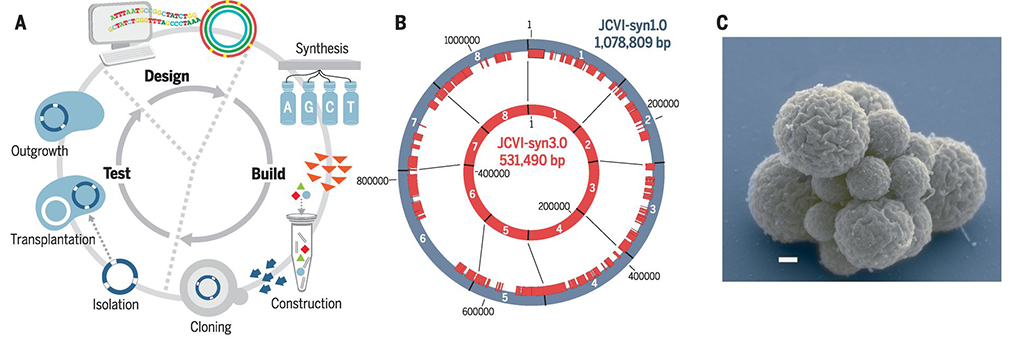
A team of scientists led by renowned biologist Craig Venter has made a breakthrough some 20 years in the making: they've managed to create a species of bacteria in the lab with a genetic code that's smaller than any found in nature. With just 437 genes, the lab-made organism is carrying the absolute known minimum amount of genetic code required to support life.

By creating this self-replicating bacterium, scientists from the Synthetic Genomics lab and the J. Craig Venter Institute hope to get a better understanding of the function of the individual genes that make up every living organism - while we're making new discoveries all the time, there's still a lot we don't know about these vital biological building blocks.
Of the catchily named JCVI-syn3.0 microbe's 437 genes, only 149 have a known function. In other words, we know the rest are necessary for life to exist, but we haven't figured out what their purpose is yet. To help scientists find out more, what Venter and his team are now learning from this experiment is being added to a public database so anyone can study them.
"Our attempt to design and create a new species, while ultimately successful, revealed that 32 percent of the genes essential for life in this cell are of unknown function, and showed that many are highly conserved in numerous species, we must find out what are the functions of the genes and are they harmful or not. " said Venter. "All the bioinformatics studies over the past 20 years have underestimated the number of essential genes by focusing only on the known world."
The challenge now is to figure out the function of those mysterious 149 extra genes, and take the study of synthetic life further still - the researchers admit it might be possible to create a living organism with even fewer genes further down the line. "We view life as DNA software-driven," Venter said in a press statement. "And we're showing that by trying to understand that software, we're going to get better understandings of life."
His team's work has now been published in the journal Science.

437-genes

The London Underground Mosquitoes

Humans are 'creating new species' including a bizarre breed of mosquito that lives underground


We are all familiar with how human activities are driving the extinction of species around the world. Humans are in fact causing the rapid evolution and making new species of plants and animals emerge, according to a new study.

As the common house mosquito adapted to the environment of the underground railway system in London, it established a subterranean population. Now named the 'London Underground mosquito', it can no longer interbreed with its above ground counterpart and is effectively thought to be a new species. 

The study, led by the University of Copenhagen, outlined many examples of the process of man-made speciation, where human activities lead to the introduction of a new species.The process can take place by accident, through the emergence of new ecosystems like urban environments, or through the domestication of animals and crops. Unnatural selection caused by hunting can lead to new traits emerging in animals, which can eventually lead to new species.
The deliberate or accidental relocation of species can lead to hybridization with other species. This has meant more new plant species in Europe have appeared than are documented to have become extinct. These new species might be harmful and bring many unknown and dangerous disease that cannot be cured.
Image result for london underground mosquitoes

Environment

Poll Shows Americans Don't Care That Much About the Environment

Americans care less about environmental issues now than they have in the past and they're no more worry about global warming then they were decades ago, a new poll shows. 

The Gallup survey on Wednesday shows Americans were more concerned about the environment in the late 1980s and early 1990s, but interest dropped off in the 2000s. Since then it's remained close historic laws. And when it comes to global warming specifically, Americans are no more worried now than they were in 1989.

In the recent survey, which questioned 1,025 U.S. adults in early March,  Americans reported feeling the most concerned about drinking polluted water and least worried about global warming. In 1989, 35%of the men and women surveyed said they cared a great deal about climate change, but only 32% said the the same thing in 2015. Even when it came to polluted water, just 55% of the Americans reported caring a great deal, down from 65% in 1990.

Gallup notes that the state of the economy could play a roll in how concerned Americans are about the environment. Americans tend give environmental concerns a higher priority when the economy is doing well, Gallup says.
Image result for american

Air pollution doesn’t just harm humans – it is destroying nature too

The poisonous residue from car exhausts is causing a public health crisis – and could be the death of sparrows too


You may never have heard of cow parsley syndrome, yet it’s been visible over much of Britain for the past month – the spectacle of country roads fringed with a dense throng of tall white feathery flowers, three- to four-feet high, which many people now think of as an attractive addition to the landscape. It’s a pity they do, for the point about the syndrome is this: there’s lots of cow parsley, sure. But there isn’t anything else.


Along mile after mile of our rural highways, especially the closer you get to London, every spring you will see masses of this frothy foam. But what you often won’t find is the lovely variety of wildflowers that 30 to 40 years ago decorated these same roadside verges: comfrey, lady’s smock, garlic mustard, early purple orchid and many more. The cow parsley has largely crowded them out because it has been fertilised into excessive growth. Much of the fertiliser has come in the form of nitrogen compounds from car exhausts, especially diesel ones – a striking example of how air pollution from motor vehicles is impacting on the natural world.

We know only too well how it impacts on us. Causing up to 40,000 premature deaths a year, air pollution in Britain is now right at the top of our list of environmental health concerns. It is seen in human terms as a crisis and a public health emergency. Vehicle emissions are breaking EU air quality laws, and the government has had to be ordered by the supreme court to find an effective strategy. 
A country lane in Somerset

Wednesday, 14 June 2017

KLIA Customs seizes RM9 million record haul of Pangolin scales

The Kuala Lumpur International Airport's (KLIA) Customs Department has seized 712 kilograms of Pangolin scales, worth RM9.12 million, which were smuggled in from Congo and Ghana.

Displaying the seized items at Kompleks Kastam Kargo, here, its enforcement assistant director general Datuk Paddy Abd Halim said the seizures were made possible following a tip-off.
"We were alerted by an informer about this and deployed our officers to investigate."
The Pangolin scales, he said, were smuggled in two separate batches, dated May 1 and May 2 respectively.
"The first batch was labelled as 'General Product' while the second batch as 'Dry Herbs'," he said.
Paddy said his team has yet to ascertain if the smuggled Pangolin scales were meant for domestic or overseas market.
"They used a fake company address in Nilai. So, we are not sure and are still investigating it," he said.
He added that the first batch was flown in via Emirates Airways from Accra, Ghana and transited in Dubai while the second batch was flown in via the same airline from Kinshasa, Congo and also transited in Dubai.
Wildlife Department (Perhilitan) deputy director Rozidan Md Yasin said the Pangolin scales could fetch a price of between RM 1,000 to RM 1,500 per kg in the Malaysian market.
"They can fetch a higher price in China because of the big demand there."
He said this was because the scales were considered to have medicinal properties and used as traditional remedy for malaria and cancer.
Rozidan said even though there was no scientific research to back the claim, Pangolin meat could be sold for RM200 to RM300 per kg.
"I believe they (the seized scales) are from pangolins in Africa, because the scales are of larger size." he added.
Import of Pangolin scales requires a special permit from Perhilitan.
Under Section 135 (1) (a) of the Customs Act 1967, those found guilty of illegally importing it into the country can be fined a maximum of 20 times the value of the smuggled items, or face three years imprisonment, or both.
Meanwhile, KLIA Customs director Datuk Hamzah Sundang pledged a handsome cash reward for those who could provide authorities with valuable information on the smugglers' whereabouts.

G, T, A, C, and X Y

Scientists create new life form in a lab, altering the fundamentals of DNA The work has been able to 'lay the foundation for achievin...